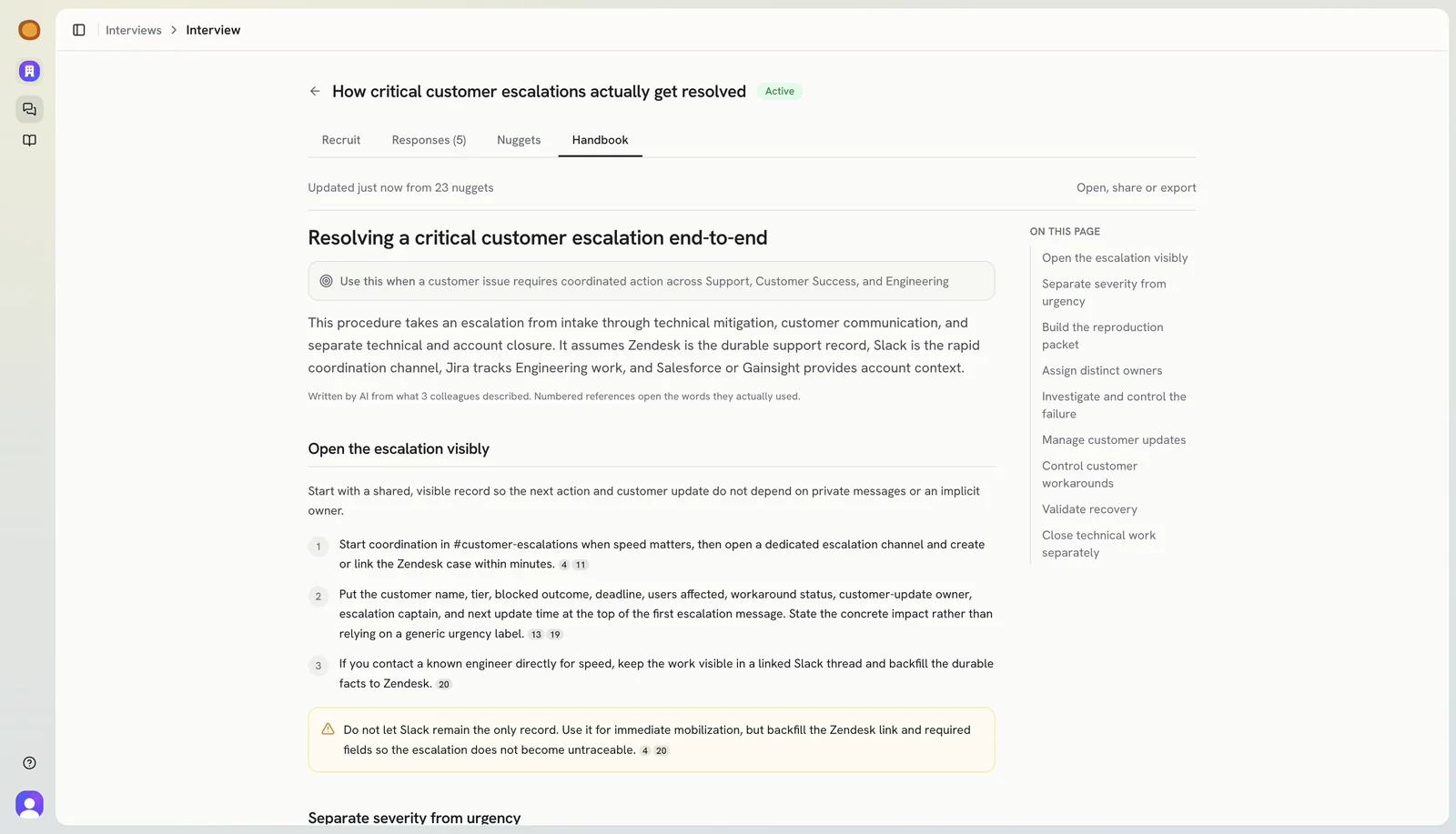
Nuggetz runs an AI-moderated interview with the people who already know the job, then turns what they say into a handbook. You describe what you need to learn, share one link, and colleagues answer by speaking or typing. Nuggetz captures the reusable knowledge, checks it against everyone else who answered, and writes the settled part down.
Updated · Nuggetz
What is a knowledge interview?
A knowledge interview is an AI-moderated conversation with an experienced colleague, shared as a single link, that asks follow-up questions and turns the answers into reusable operational knowledge.
The written process is never the whole job. Experienced people know which signals matter, which systems can be trusted, when to escalate and which shortcuts are safe. Almost none of it is written down, because writing it means the expert stops doing the work and becomes an author. A knowledge interview inverts that: the expert answers questions, which is something they can do between two other things, and the writing happens afterwards.
01
How do you design an interview without writing the questions yourself?
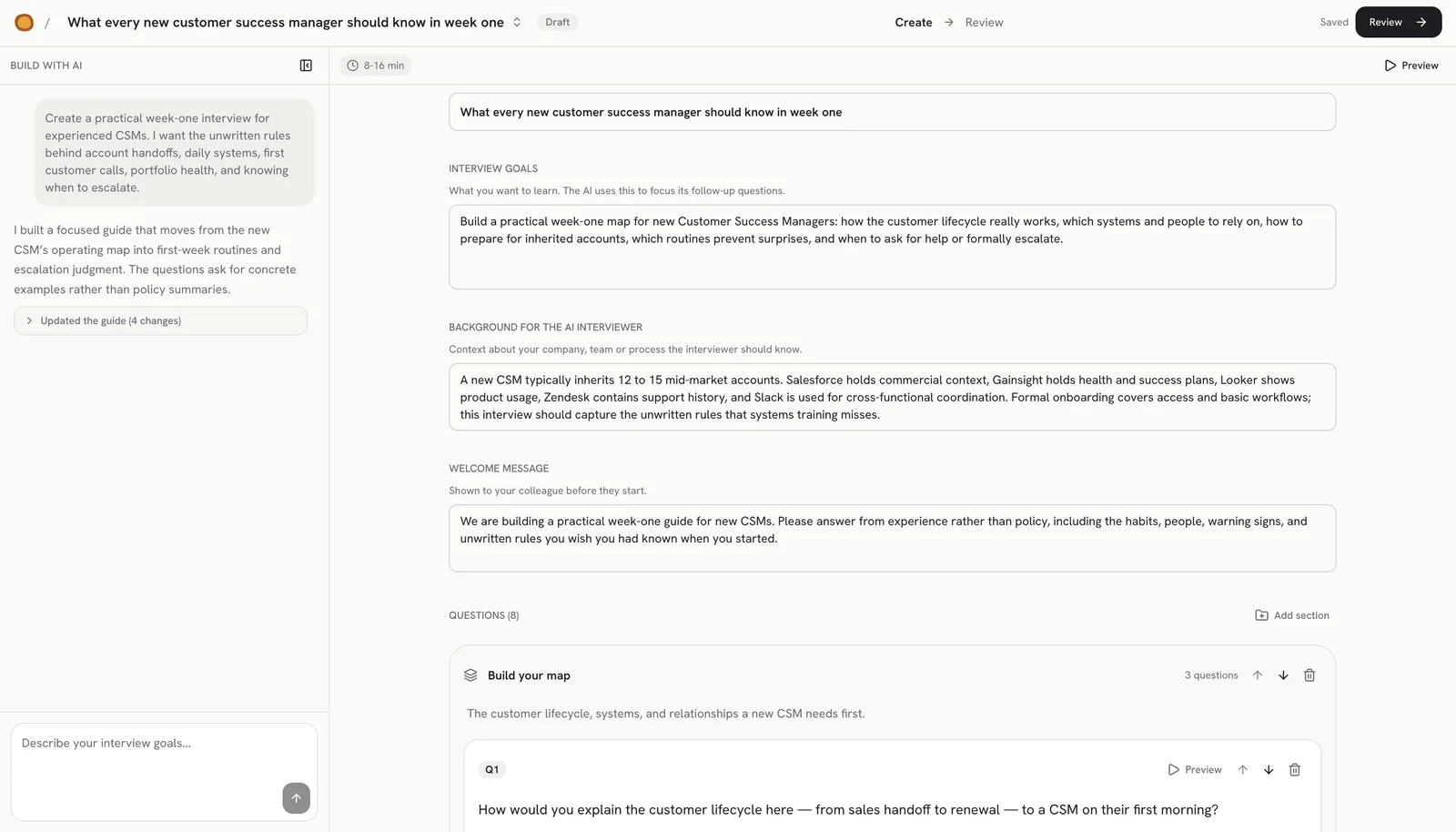
You describe what you need to learn, and Nuggetz drafts the guide — goals, background and questions — which you edit before anyone sees it.
Most attempts at writing knowledge down die here. Sitting an expert in front of a blank document makes them an author, which is not their job and rarely their talent. Starting from a draft moves the work from writing to correcting, and correcting is fast.
Rehearse the guide yourself before you share it. If a question produces a vague answer from you, it will produce a vaguer one from someone with less patience for the exercise. Questions are open-ended only: there is no branching, no skip logic, no ratings and no multiple choice, because the useful part of what an expert knows never fits a fixed set of options.
02
How do colleagues take part without an account?
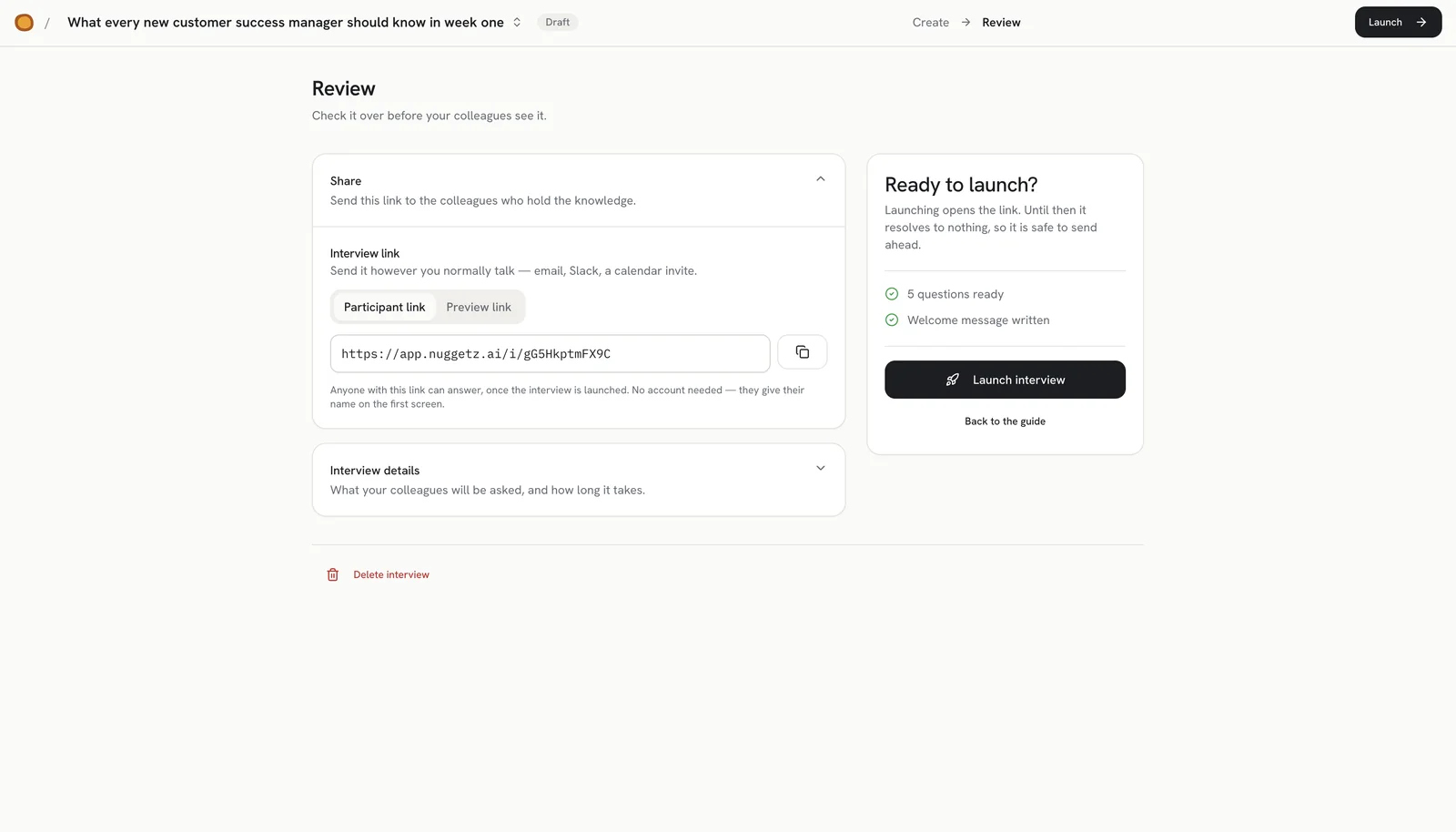
You share one link, and the people answering need no account, no seat and no invitation from us.
They give a name on the first screen. Email is optional. The link goes wherever your team already talks, which means participation costs a colleague one click rather than a password reset and a licence request.
Two limits worth knowing before you plan around them: Nuggetz sends no invitations and no reminders, and there are no per-person links. Chasing people stays your job, and so does deciding who to ask. For a handover or an escalation procedure that is usually five names you already have in your head.
03
How does the interview go deeper than a written form?
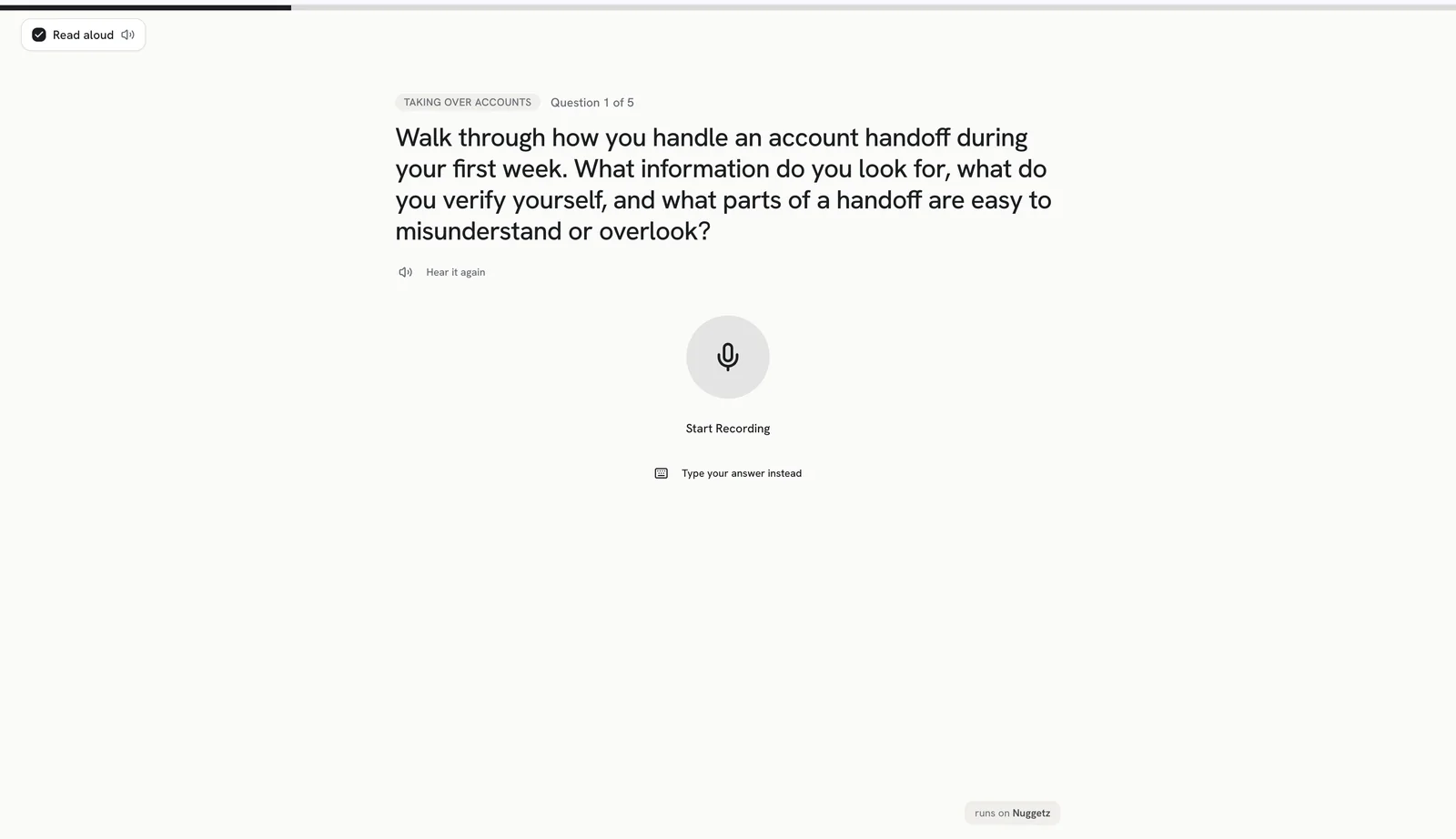
The AI asks one question at a time and follows up when an answer contains something worth exploring — which a static form cannot do.
Colleagues speak or type, whichever suits them. Spoken answers are transcribed and the recording is discarded. When someone says an escalation is "usually" fine, the follow-up asks what makes it unusual; when the conversation wanders, it redirects. That second question is the whole difference between a transcript and knowledge worth reusing.
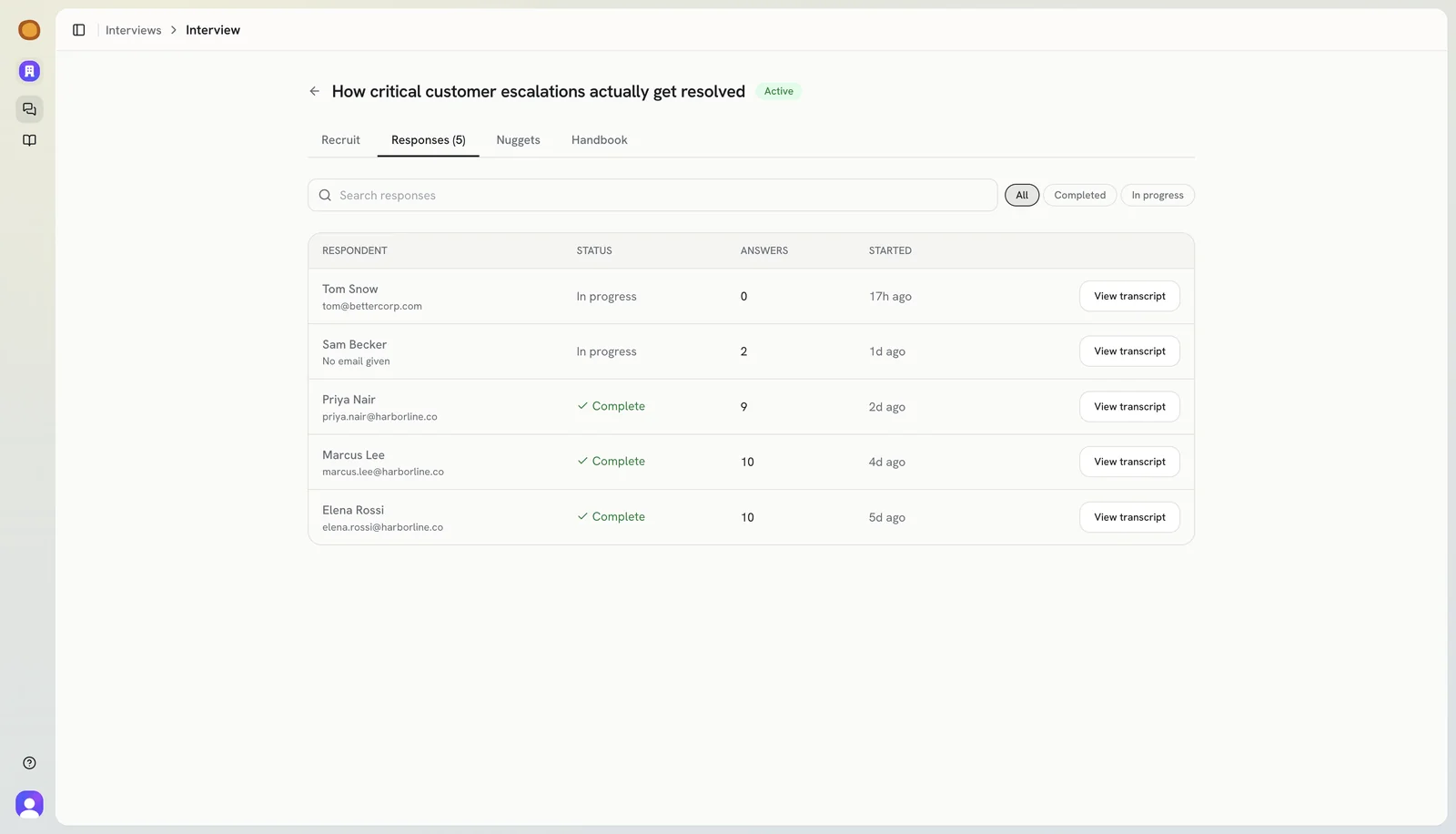
Every completed response comes back with a half-minute summary and the full transcript underneath, so you can see what one colleague contributed beside the words they actually used. If the interview offers more than one language, the colleague picks theirs on the first screen and the whole interview — questions, follow-ups, read-aloud and transcription — runs in it.
04
How does Nuggetz know which answers to trust?
Each answer becomes nuggets, and Nuggetz compares them across everyone who answered, marking each one confirmed, single source, conflict or gap.
A nugget is one self-contained piece of operational knowledge: a how-to, a judgment call, a gotcha, a why, or a who and where. Cutting a conversation into nuggets is what makes two people's answers comparable in the first place.
Confirmed means several colleagues independently said the same thing. It does not mean anyone checked the claim against the outside world, and we would rather say that plainly than let the word carry more than it earns. The statuses you should read closely are the other two: a conflict is two experienced people who disagree about how the work is done, and a gap is a question nobody could answer. Both are findings. One expert is enough to begin — more people confirm or challenge what the first one said.
05
How does an interview become a handbook?
The settled knowledge becomes a document a colleague can follow, and every instruction in it stays linked to the interview that produced it.
Conflicts and gaps do not quietly disappear into the prose. They stay visible under "Still unresolved", including for whoever you share the handbook with, so a reader can tell the difference between what the team agrees on and what it has not settled yet.
Share a handbook by link — private by default, revocable immediately — or export it as Markdown into the wiki you already keep. Handbooks do not rewrite themselves: when the underlying knowledge moves, Nuggetz says so and offers a rewrite you approve. You edit or resolve the nugget and then rewrite, rather than editing the generated prose, so the document and its evidence never drift apart.
Frequently asked questions
Do the people I interview need an account?
No. You share one link, they give a name on the first screen, and email is optional. There is no seat, no password and no allowlist for the people answering.
Does Nuggetz invite or remind people for me?
No. Nuggetz sends no invitations, reminders or scheduling, and there are no per-person links. You choose who to ask and share the link yourself, in whatever channel your team already uses.
Can colleagues answer by speaking instead of typing?
Yes. Answers can be spoken or typed. Spoken answers are transcribed and the recording is discarded. Respondents cannot attach files, images or video — the interview is a conversation, not an upload.
Can I use multiple-choice or rating questions?
No. Nuggetz asks open-ended questions only, with no branching, skip logic, ratings or multiple choice. Fixed options would cap an answer at what you already thought to ask, and the useful part of what an expert knows is usually the part you did not anticipate.
How many people do I need to interview?
One experienced colleague is enough to begin. Interviewing more people is what turns a single account of the work into knowledge marked confirmed, and what surfaces the conflicts between how two people actually do the job.
What does "confirmed" mean in Nuggetz?
Confirmed means several colleagues independently corroborated the same nugget. It does not mean the claim was checked against the outside world, and Nuggetz is not an audit-grade record.
Can the whole team search everything Nuggetz has captured?
Not as one library. Nuggets are searched and filtered inside the interview that captured them. What you hand to the team is a handbook — one document per subject, shared by link or exported into the systems they already read.
Does the handbook update itself when the process changes?
No. Nuggetz detects when the underlying knowledge has moved and offers a rewrite you approve. Handbooks never silently rewrite themselves, and you edit the underlying nugget rather than the generated prose.
Does Nuggetz integrate with our wiki, or join our calls?
Neither, today. Nuggetz has no direct integrations and does not capture live meetings. Handbooks export as Markdown, which you paste into Confluence, SharePoint, Notion or any wiki. There is no CSV or PDF export.
What languages do interviews run in?
Twenty-eight to choose from, and one interview can offer six of them on a single link — the language you write it in, plus up to five more. Your colleague picks theirs on the first screen and answers entirely in it — questions, AI follow-ups, the read-aloud voice and the transcription of what they say. Summaries, nuggets and the handbook then come back in one language you choose, so answers given in different languages still reconcile into one document; quotes stay in the words the colleague used. Nuggetz itself — the builder and dashboard you work in — is in English.
See it with your own team's knowledge
The fastest way to judge whether this works is to pick one thing your team has never written down — an escalation procedure, a handover, the way a high performer decides — and run an interview about it.